Home > Products > Data Loggers > XORAYA ML-N4000
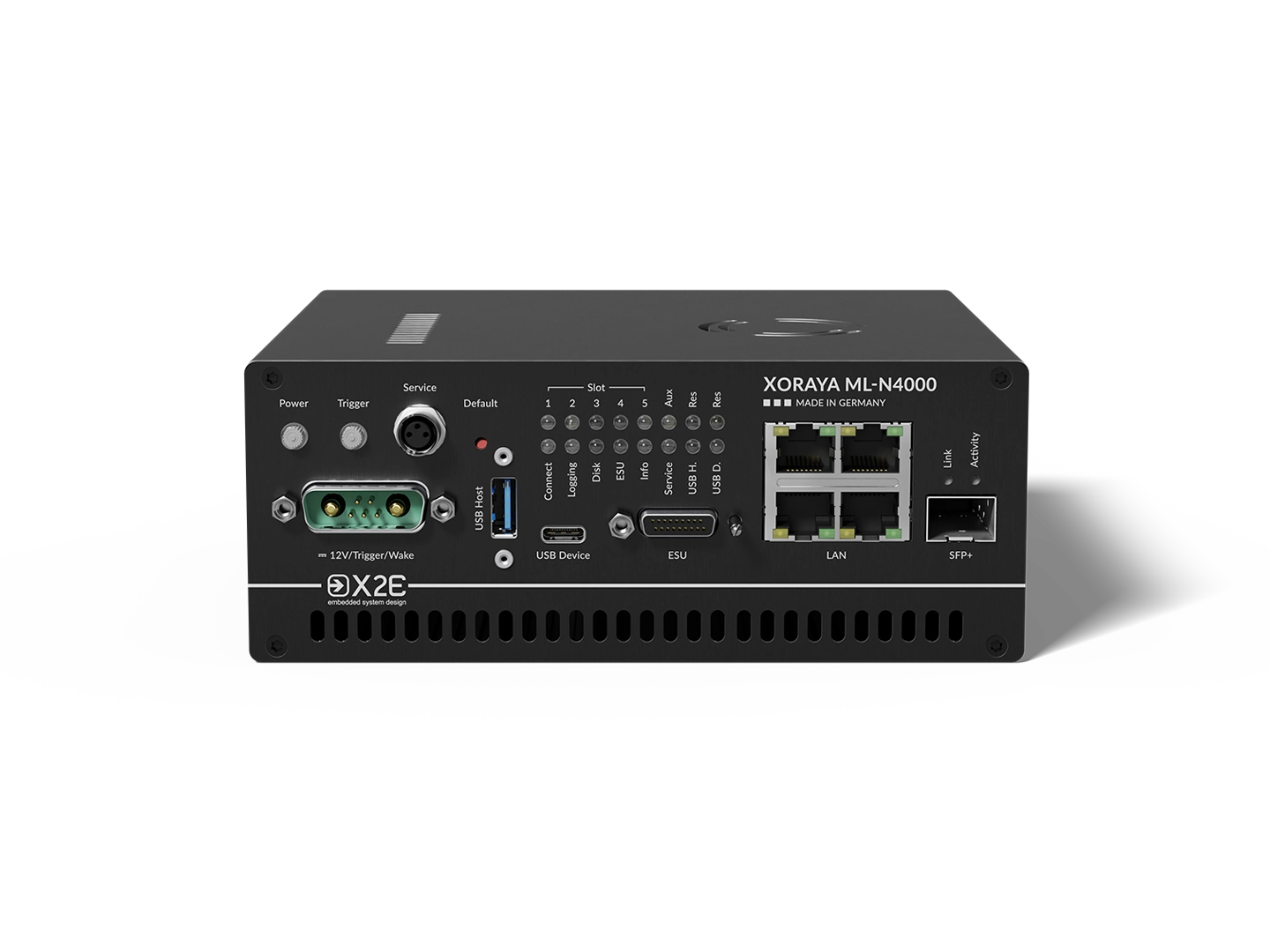
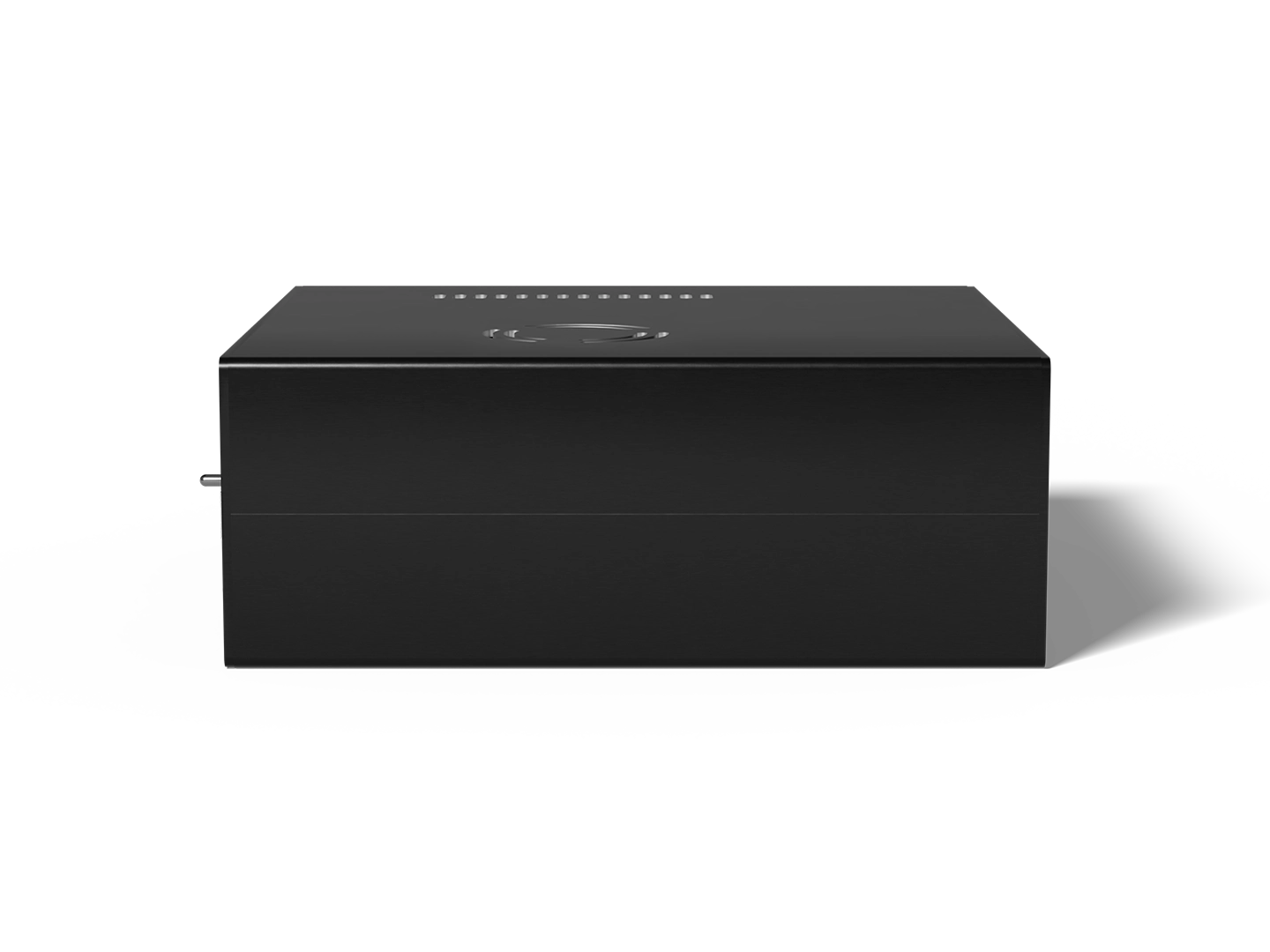
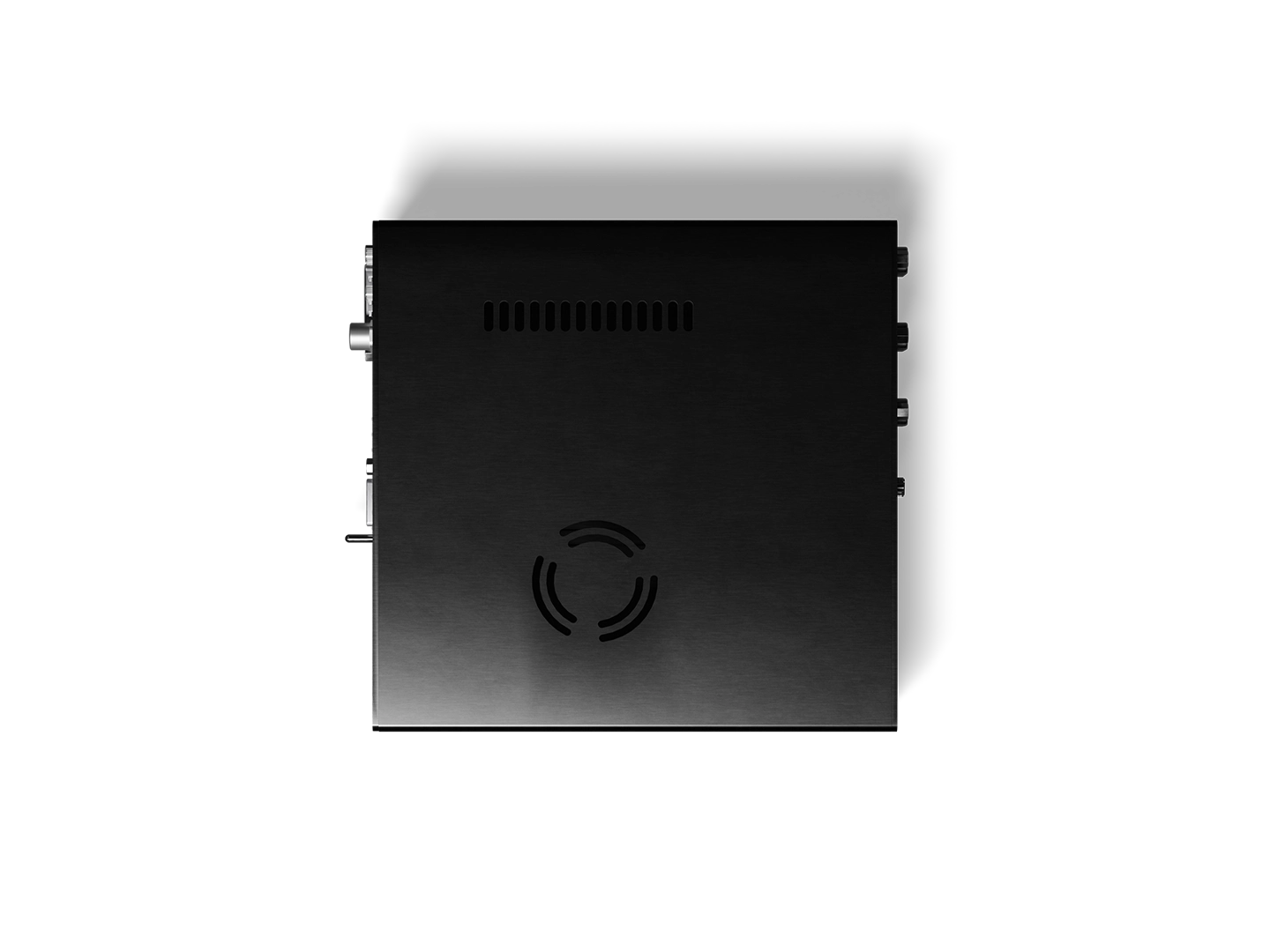
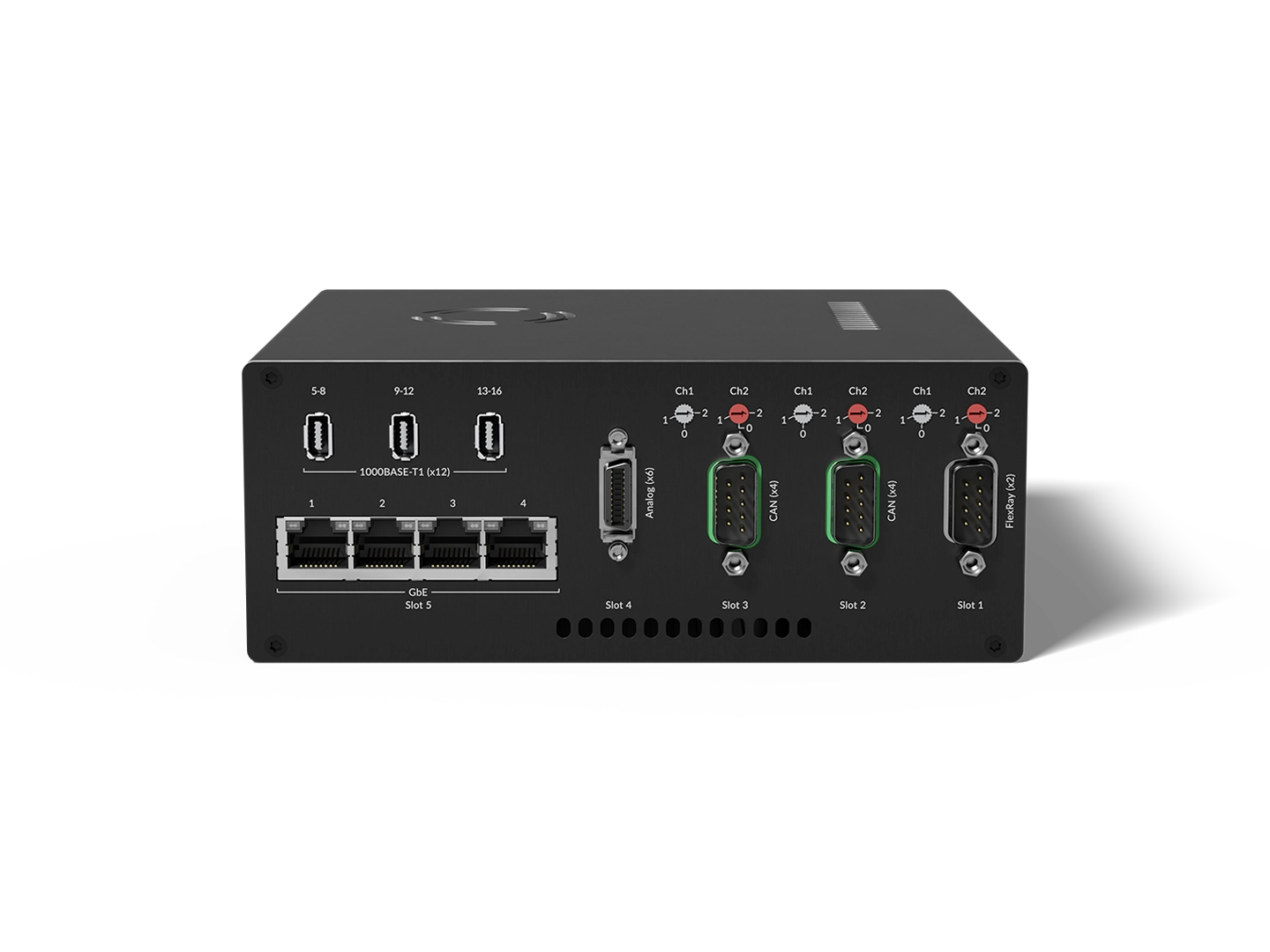
XORAYA ML-N4000
An inexpensive and compact data logger with a wide range of applications.
- More compact version of the XORAYA N4000
- Up to 3 Gbit/s recording speed
- Available in several interface variants
- Cascadable via probes and data loggers
- 480 GB internal / up to 8 TB external (optional)
| Data rate | Up to 3 Gbit/s |
|---|---|
| Storage capacity | 480 GB internal / up to 8 TB external (optional) |
| Timestamp | 100 ns |
| Temperatures | -40 to +65 °C |
| Dimensions | 65 x 165 x 165 mm |
| Bus systems | HS-CAN/CAN-FD, RS-232, FlexRay, LIN, Analog, 100/1000BASE-T1, Gbit Ethernet |
|---|---|
| Configurations | |
| Note | Other interfaces and configurations on request |
Product details
Product description
With its extensive range of interfaces, the XORAYA ML-N4000 can be used wherever data from different bus systems needs to be recorded. Despite its compact dimensions, the powerful hardware enables recording rates of up to 3 Gbit/s. The data can be written to an internal or external storage and forwarded to a third-party system via Ethernet.
Device variants
The data logger is available in different device variants, which differ primarily in their interface configuration. Eleven variants are available as standard:
| Configuration 1 (R8C4GE4) |
|
| Configuration 2 (R8C8GE4) |
|
| Configuration 3 (R8C4B12) |
|
| Configuration 4 (R8C4GE4B12) |
|
| Configuration 5 (R8C8GE4B12) |
|
| Configuration 6 (R8C8L7GE4B12) |
|
| Configuration 7 (L7C8) |
|
| Configuration 8 (L7C8F2) |
|
| Configuration 9 (L7A6C8B12) |
|
| Configuration 10 (C8R8A6GE4B12) |
|
| Configuration 11 (C8F2A6GE4B12) |
|
Features & functions
The device has extensive functions for configuring, controlling and analyzing data recordings. The following list shows an excerpt of key functions. A complete description can be found under Technical data or the Software tab.
- Configuration of hardware and software interfaces
- Import of common signal description files (e.g. DBC, FIBEX)
- Definition of signals and trigger conditions
- Trigger-controlled data recording and snapshots
- Live monitoring of messages and signals including graphical display
- Download and management of recorded data from internal and external storage devices
- Analysis, filter and search functions for measurement data
- Export of recordings in common analysis formats (e.g. BLF, MDF, PCAP)
Front & rear view
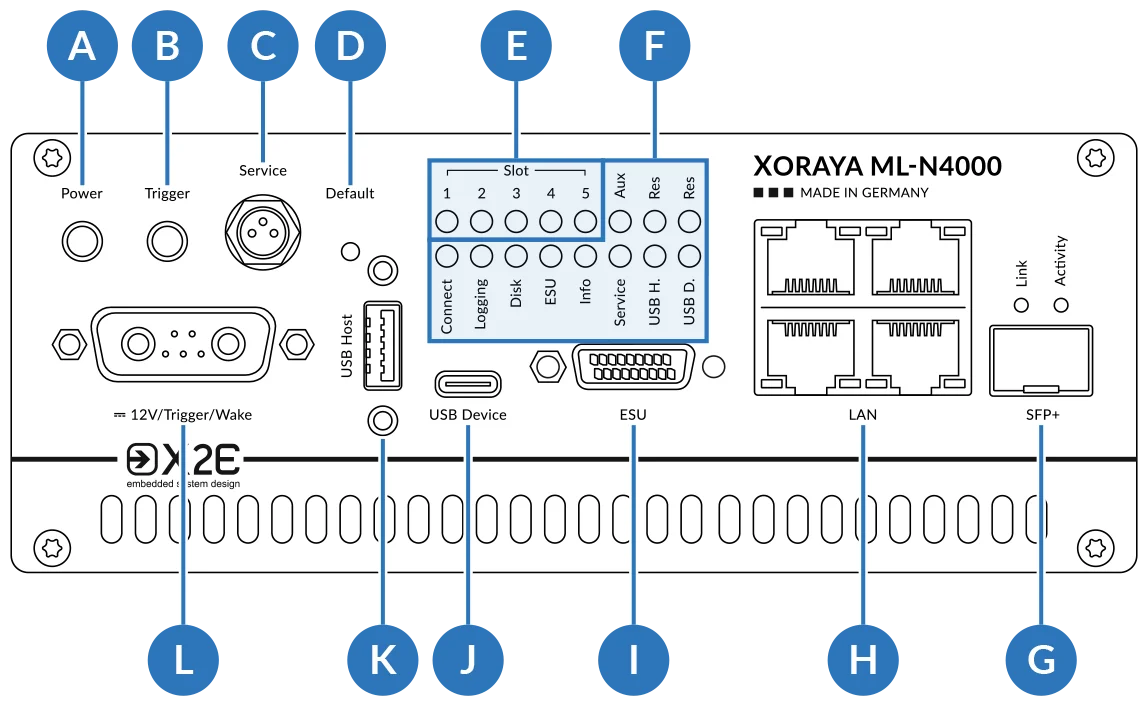
| A | Power button |
| B | Trigger button |
| C | Service port |
| D | Default button |
| E | Status LEDs of the log interfaces |
| F | General status LEDs |
| G | SFP+ interface |
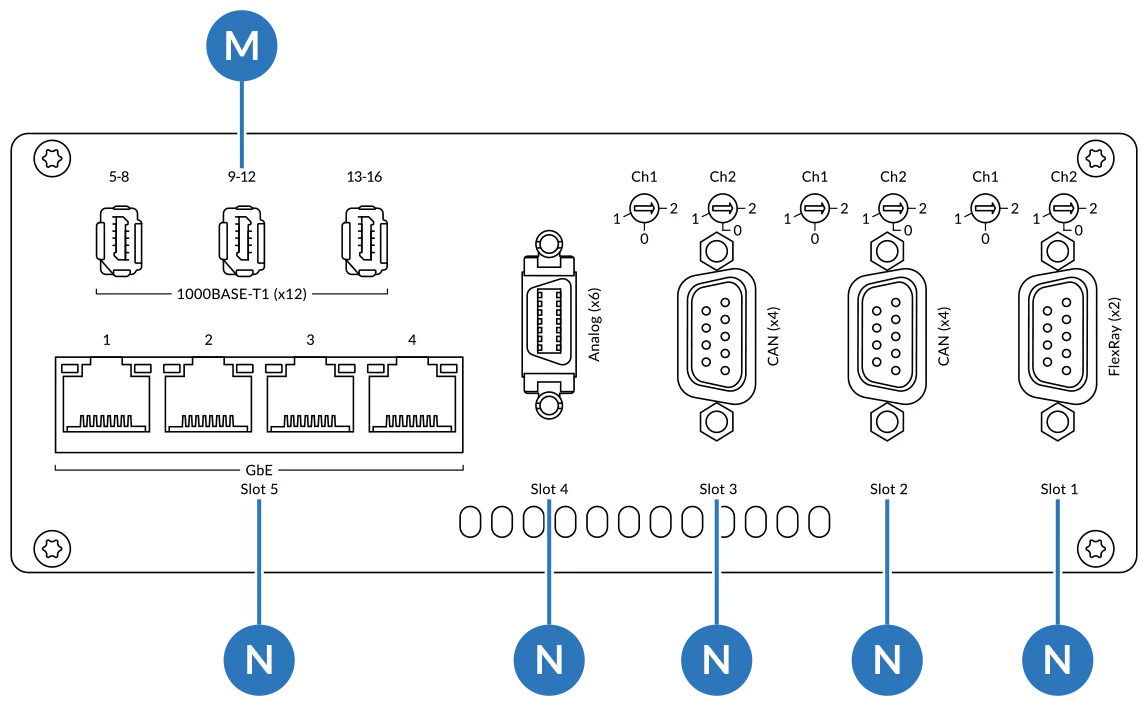
| H | LAN interfaces |
| I | ESU interface |
| J | USB Device interface |
| K | USB Host interface |
| L | 12V/Trigger/Wake connection |
| M | Add-on log interface |
| N | Log interfaces |
Areas of application
Thanks to its modular architecture and comprehensive support for all common automotive interfaces, the data logger is suitable for a wide range of development, testing and analysis tasks.
- Vehicle testing and data acquisition in road tests
- Data recording and analysis in development and test environments
- Analysis and monitoring of bus systems (CAN, FlexRay, Automotive Ethernet, LIN, etc.)
- Analysis and validation of E/E architectures
- Diagnostic communication and troubleshooting in the vehicle network (e.g. UDS, DoIP)
- Recording of sensor and raw data for ADAS and automated driving functions
- Fleet tests and large-scale data acquisition across several vehicles
Project-specific adaptations
Thanks to a modular system architecture, our solutions offer flexible customization options for development and test projects. Individual hardware and function configurations enable seamless integration into existing vehicle and test environments.
- Additional interfaces and special protocols
- Range of functions, trigger logics and export formats
- Capture speed, storage and system performance
- Customized installation racks and complete vehicle integrations
Verification, tests & conformity to standards
All devices undergo comprehensive verification tests, including functional tests, boundary scan tests and system tests as well as EMC tests. In addition, mechanical function and wear tests, vibration tests and temperature and humidity tests are carried out to ensure reliability under real operating conditions.
We also carry out compliance tests for automotive and standard Ethernet interfaces using Teledyne LeCroy measurement systems and QualiPHY software. This produces standard-compliant, reproducible measurement results that enable reliable integration into vehicle networks and development environments.
Our development and business processes meet the requirements of ISO 9001 and ISO 14001. X2E is also certified according to TISAX® (ENX Association) and meets the information security requirements of the automotive industry. All devices bear the CE mark and comply with the applicable European directives.
Technical data
All key technical specifications of the XORAYA ML-N4000 are clearly and concisely summarized below.
Hardware
| Processor | Quad ARM Cortex-A53 |
|---|---|
| Memory | 8 GB RAM / 128 MB Flash |
| Data rate | Up to 3 Gbit/s |
| Storage | 480 GB internal / up to 8 TB external (optional) |
| Recording modes | Internal Storage, External Storage Unit, PC via Ethernet |
| Timestamp | 100 ns |
| External operating voltage | 12 V DC (temporarily 6 to 32 V) |
| Power consumption (at 12 V) |
|
| Temperatur range | -40 to +65 °C |
| Dimensions | 65 × 165 × 165 mm (H × W × D) |
| Weight | 2.2 kg |
| Housing | Aluminum anodized |
| Other | Hermetically sealed active cooling, real-time clock, powercap unit |
Software
| Operating system | Embedded Linux |
|---|---|
| Storage formats | X2E Native, X2E ASCII, Carmen-Journal (V3.0), Wireshark PCAP/PCAPNG, Vector BLF, Vector ASCII, XAA for GNLog, DLT AUTOSAR, System Events, NMEA for GPS, Raw RS-232, CSV for Analog/CCP, CSV for Signals, Video Extractor, MATLAB signals, MDF Signals/Buslogging |
| Software protocols | CCP/XCP, PLP, XLP |
| Wake up by | CAN, FlexRay, RS-232, LIN, PSI5, Wakeline oder Trigger |
| Software | XORAYA Suite, XORAYA WebGUI and XORAYA SDK for Windows & Linux |
| Other | Automatic Sleep Mode |
Interfaces
| Out-of-the-box Configurations | |
|---|---|
| Configuration 1 (R8C4GE4) |
|
| Configuration 2 (R8C8GE4) |
|
| Configuration 3 (R8C4B12) |
|
| Configuration 4 (R8C4GE4B12) |
|
| Configuration 5 (R8C8GE4B12) |
|
| Configuration 6 (R8C8L7GE4B12) |
|
| Configuration 7 (L7C8) |
|
| Configuration 8 (L7C8F2) |
|
| Configuration 9 (L7A6C8B12) |
|
| Configuration 10 (C8R8A6GE4B12) |
|
| Configuration 11 (C8F2A6GE4B12) |
|
| Other Interfaces | |
| Non-logging |
|
All technical specifications are provided without warranty and are subject to change, inaccuracies, and errors.
Accessories
Here you will find suitable accessories for the ML-N4000. From expansion modules to integration and connection solutions for project-specific use.

XORAYA ESU
ESUs are external storage units specially designed for XORAYA data loggers such as the ML-N4000
Xoraya Datacube-C6
Readout station for up to six ESUs, as used by data loggers such as the ML-N4000
Xoraya Datacube-C6+
Enhanced version of the readout station for up to six External Storage Units
Downloads
Here you will find all relevant documents and software versions for the XORAYA ML-N4000 to support integration and application.
FAQ
In this FAQ you will find answers to key questions about the XORAYA ML-N4000 data logger – from typical application scenarios and technical features to how it compares to other solutions.
For which applications is the ML-N4000 typically used?
The XORAYA ML-N4000 is a data logger that covers a wide range of applications thanks to its six freely configurable interface slots. It was primarily developed for use in vehicle networks, but is also used in other industrial applications.
Typical applications in the automotive sector:
- Vehicle development (control unit and function development)
- Test drives and vehicle testing
- Test benches and laboratory environments
- Analysis and diagnosis of vehicle networks
- Function validation (e.g. infotainment)
- Quality assurance and series preparation
Further areas of application:
- Medical technology (e.g. recording and analysis of device communication)
- Mechanical engineering (status and process data logging)
- General networked systems with comparable communication structures
Which devices is the ML-N4000 compatible with?
The XORAYA ML-N4000 is compatible with external memories (XORAYA ESU) to expand the storage capacity. It can also be supplemented with probes and can be combined with other data loggers from the XORAYA ecosystem to create scalable logging systems for vehicle networks.
What is the difference between an ML-N4000 and the N4000?
The XORAYA ML-N4000 data logger is the cheaper and more compact version of the XORAYA N4000 data logger. The ML stands for Minilogger.
What requirements and standards does the device meet?
The XORAYA ML-N4000 data logger was developed for use in automotive test environments and fulfills typical requirements for measurement and data recording systems in vehicle networks. It supports common automotive technologies, diagnostic standards and time synchronization procedures.
Which bus systems and interfaces does the ML-N4000 support?
Several hardware variants are available for the XORAYA ML-N4000. Each variant combines different numbers and types of supported bus systems and interfaces.
The supported bus systems and interfaces of the data logger include
- CAN (Controller Area Network)
- CAN-FD (CAN with Flexible Data Rate)
- LIN (Local Interconnect Network)
- FlexRay
- Automotive Ethernet (100BASE-T1, 1000BASE-T1)
- Gigabit Ethernet (1000BASE-TX)
- Analog (Analog inputs)
- RS-232
These hardware configurations enable the parallel recording of several vehicle networks with a single automotive data logger.
What software solutions can be used to operate and analyze the ML-N4000?
Like all XORAYA logging products, the ML-N4000 can be configured, read, and operated using the XORAYA Suite. The Suite provides customers with full functionality for working with the data logger, and no additional tools need to be installed separately. One installation—and the customer has everything under control.
To operate and automate the data logger on the test bench, X2E also offers the XORAYA SDK. In addition, the XORAYA mobile app for smartphones and tablets is supported.
What advantages does the modular architecture of the XORAYA ML-N4000 offer?
The XORAYA ML-N4000 data logger is based on a modular hardware and software architecture that enables flexible adaptations for specific development and test projects. This allows the system to be seamlessly integrated into existing vehicle and test environments.
- Additional interfaces and special protocols
- Range of functions, trigger logics and export formats
- Capture speed, storage and system performance
- Customized installation racks and complete vehicle integrations
What makes the XORAYA ML-N4000 stand out from other products on the market?
The XORAYA ML-N4000 combines broad interface support, modular expandability and solid data bandwidth in one system. This means that several vehicle networks – including automotive Ethernet – can be recorded in parallel. In conjunction with the XORAYA platform, scalable logging systems can also be set up for complex vehicle testing.
The XORAYA ML-N4000 differs from many data loggers on the market due to the following key features:
- Support for modern vehicle networks in one device
The ML-N4000 supports HS-CAN, CAN-FD, RS-232, FlexRay, LIN, Automotive Ethernet (100/1000BASE-T1), Gigabit Ethernet and analog inputs. This means that different vehicle networks and sensor signals can be recorded in parallel without having to use several specialized loggers. - Modular architecture for flexible test setups
The ML-N4000 offers flexible customization options for development and test projects. Tailored hardware and functional configurations enable seamless integration into existing vehicle and testing environments. - Solid data bandwidth for modern vehicle architectures
With a data bandwidth of up to 3 Gbit/s, data from several vehicle networks can be recorded simultaneously. This is particularly relevant for Ethernet-based vehicle architectures and data-intensive measurements. - Robustness for real vehicle testing
The ML-N4000 is designed for use in test vehicles and is resistant to temperature and vibration. - Expandability within a system platform
The logger can be combined with other devices and storage solutions by integrating it into the XORAYA system platform. This allows scalable logging systems with multiple devices to be set up for complex measurement tasks.