
XORAYA ASU
FPGA-based storage unit that was specially developed for high-speed applications and can reliably process and store data rates of up to 24 Gbit/s.
- High-speed data recording with up to 24 Gbit/s
- Integrated recording, storage, and retrieval device.
- Outstanding performance per watt.
- Supports ASAM CMP 1.0
| Data rate | Up to 24 Gbit/s |
|---|---|
| Storage capacity | 8, 16, 32 TB |
| Timestamp | 100 ns |
| Temperatures | -40 to +65 °C |
| Dimensions | 42 x 120 x 224 mm |
| Bus systems | 4x SFP+ (10 Gbit/s each) |
|---|
Product details
Product description
The XORAYA ASU is a state-of-the-art FPGA-based storage unit designed for high-speed data recording at up to 24 Gbps. It can be seamlessly connected via 10 Gigabit Ethernet to various streaming devices such as the XORAYA Probe B12 and the XORAYA N4000+ making it extremely versatile for a wide range of applications.
Support for the ASAM CMP protocol ensures reliable and standardized data communication and management. In addition, multiple ASU devices can be used in parallel, which significantly increases both the write speed and the total storage capacity. This scalability makes the XORAYA ASU the ideal choice for demanding environments where large amounts of data need to be logged and processed quickly and efficiently.
Device variants
The smart storage unit is available in a standardized version – there are no device variants.
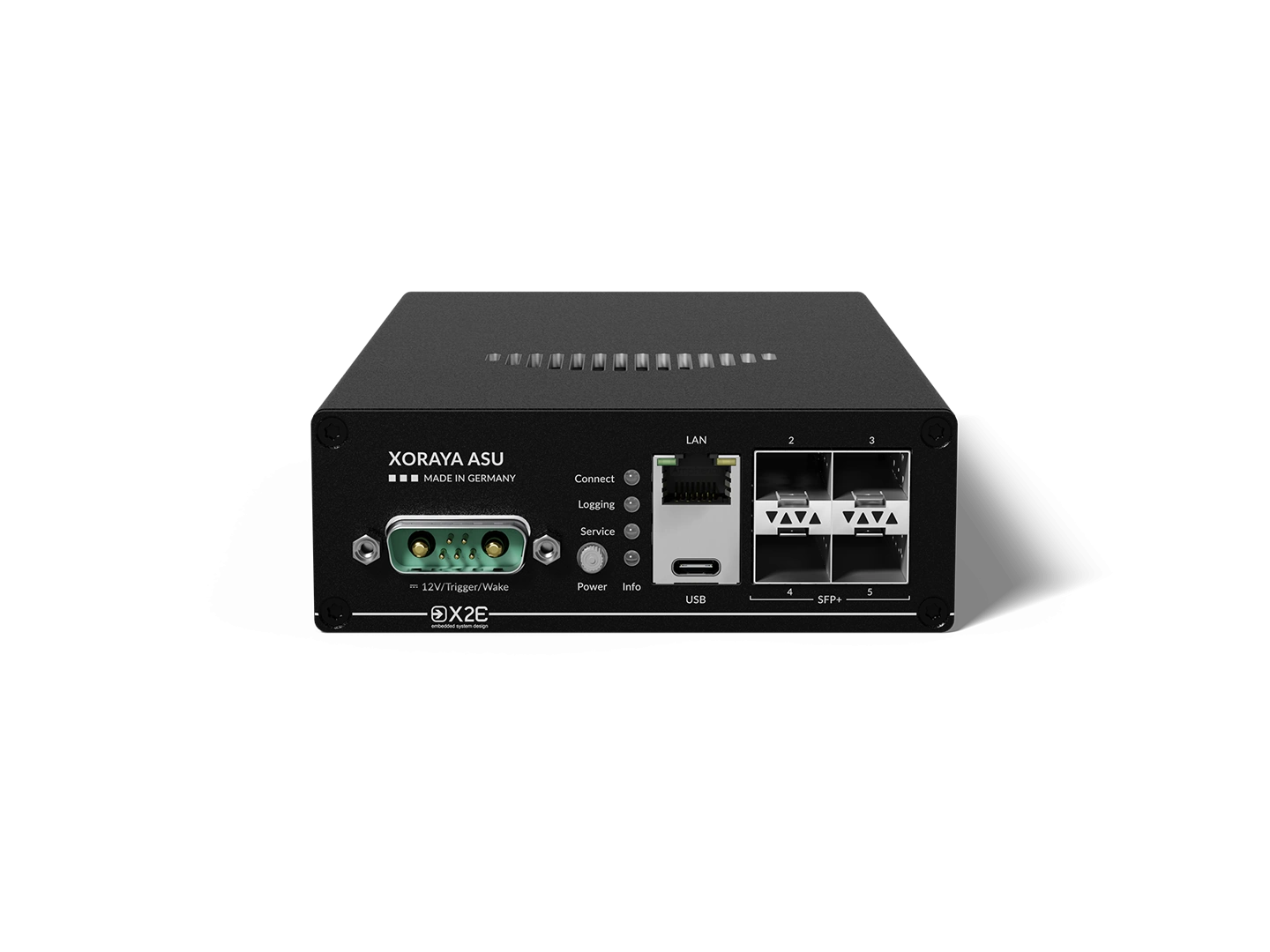
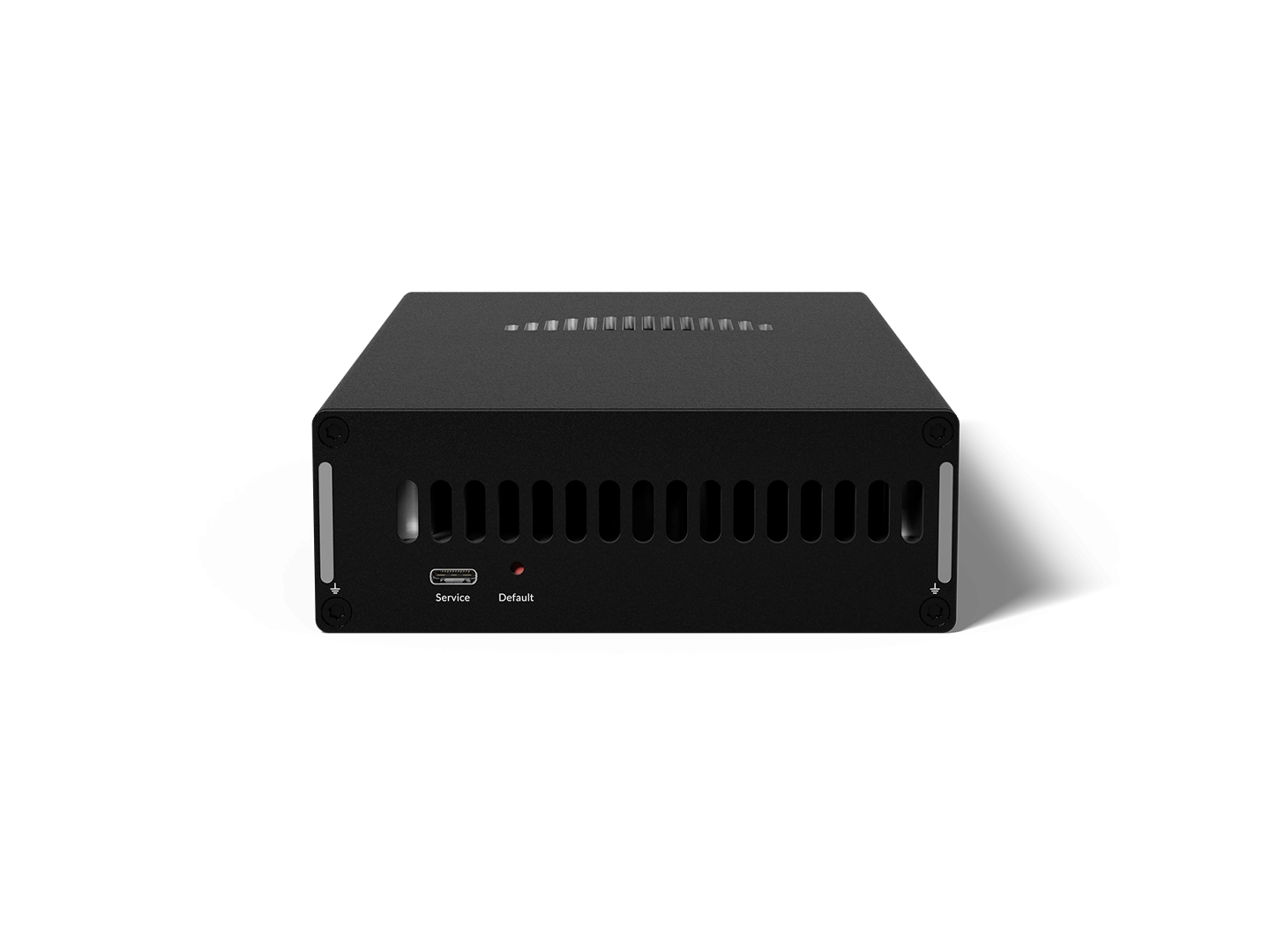
Front & rear view
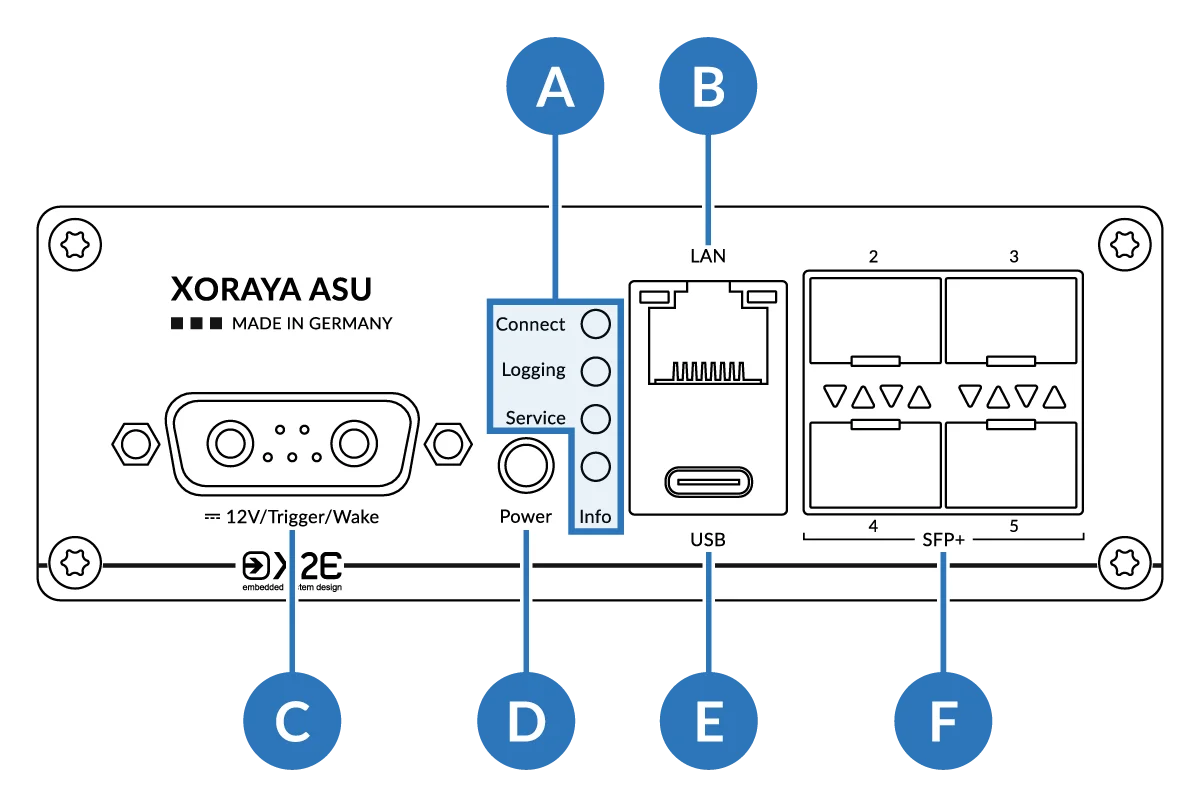
| A | General status LEDs |
| B | LAN interface |
| C | 12V/Trigger/Wake port |
| D | Power button |
| E | USB interface |
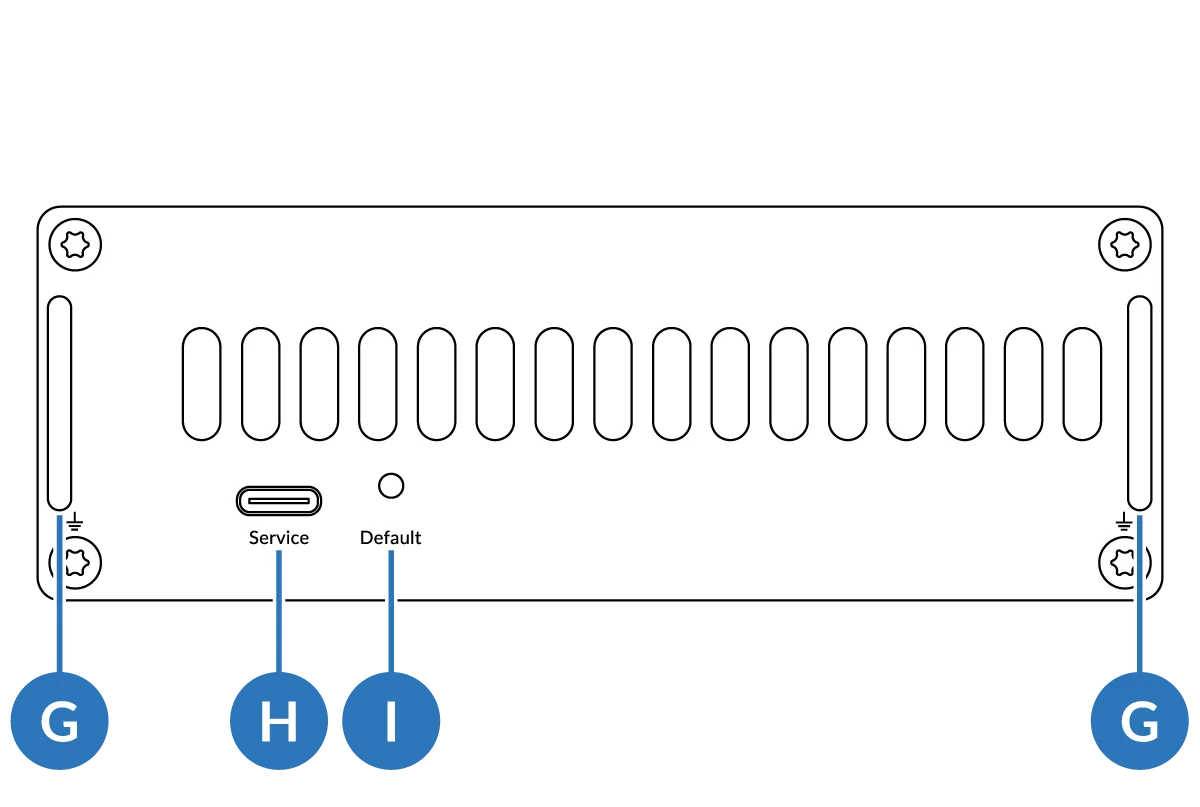
| F | SFP+ interfaces |
| G | Ground contacts |
| H | Service interface |
| I | Default button |
Project-specific adaptations
All components of the XORAYA ecosystem are designed to work together seamlessly and can be flexibly combined to create individual system solutions. The modular architecture enables targeted expansions without changing the existing system logic – for a consistent and scalable system in terms of data rate, storage, interfaces and performance.
Verification, tests & conformity to standards
All devices undergo comprehensive verification tests, including functional tests, boundary scan tests and system tests as well as EMC tests. In addition, mechanical function and wear tests, vibration tests and temperature and humidity tests are carried out to ensure reliability under real operating conditions.
We also carry out compliance tests for automotive and standard Ethernet interfaces using Teledyne LeCroy measurement systems and QualiPHY software. This produces standard-compliant, reproducible measurement results that enable reliable integration into vehicle networks and development environments.
Our development and business processes meet the requirements of ISO 9001 and ISO 14001. X2E is also certified according to TISAX® (ENX Association) and meets the information security requirements of the automotive industry. All devices bear the CE mark and comply with the applicable European directives.
Technical data
Here you will find a clear and compact summary of all the technical data.
Hardware
| Storage capacity | 8, 16, 32 TB |
|---|---|
| Write speed | Up to 24 Gbit/s |
| Read speed | Up to 24 Gbit/s (with standard network components) |
| External operating voltage | KL30: 12 V / 24 V DC (temporarily 6 to 32 V) USB-PD: Power Delivery Profile 4, 20 V/3 A |
| Power consumption (at 12 V) |
|
| Temperatur range | -40 to +65 °C |
| Dimensions | 42 x 120 x 224 mm (H × W × D) |
| Weight | 1.4 kg |
Software
| Storage formats | MDF, PCAP |
|---|---|
| Software protocols | PTP (IEEE 1588), gPTP (IEEE 802.1AS) |
Interfaces
| Logging |
|
|---|---|
| Non-logging |
|
All technical specifications are provided without warranty and are subject to change, inaccuracies, and errors.
Accessories
Here you will find suitable accessories for the XORAYA ASU. From expansion modules to integration and connection solutions for project-specific use.

Xoraya N4000+
Further development of the XORAYA N4000 with added performance, cooling, interfaces and functionality
Xoraya Probe B12
Compact probe specially designed for recording automotive Ethernet signals
Xoraya MultiProbe X1
Probe that expands XORAYA data loggers and data sinks with additional interfaces
Downloads
Here you will find all relevant documents and software versions for the XORAYA ASU to support integration and application.
FAQ
In this FAQ you will find answers to key questions about the XORAYA ASU – from typical application scenarios and technical features to how it compares to other solutions.
For which specific use cases is the XORAYA ASU suitable?
The XORAYA ASU is a high-performance, stand-alone storage unit designed for the high-speed recording of large volumes of data at rates of up to 24 Gbit/s. Data recording is performed via connected probes or data loggers that interface with bus systems and supply the data streams. Data rates and storage capacity can be scaled through the parallel use of multiple units.
Typical applications in the automotive sector:
- Vehicle testing and test drives (long-term and high-speed logging)
- High-data-rate bus logging (e.g., Automotive Ethernet)
- ADAS and autonomous driving (recording large volumes of sensor data)
- HiL and test bench applications with continuous data streaming
Further areas of application:
- Robotics and AI development (data collection for training and analysis)
- Mechanical engineering and industrial systems (high-speed process data logging)
- Research and development (continuous, high-channel-count data acquisition)
Which devices is the XORAYA ASU compatible with?
The XORAYA ASU is compatible with streaming devices such as XORAYA probes and data loggers (e.g. XORAYA N4000 or N4000+) that provide data streams for recording. It is connected via 10 Gigabit Ethernet and serves as a central high-speed storage backend.
In contrast to classic data loggers, the ASU does not have its own bus interfaces for direct data acquisition, but stores the data supplied by connected devices.
What is the difference between the XORAYA ASU and other X2E data loggers and storage devices?
The XORAYA ASU is a specialized high-speed storage unit that captures data streams from connected probes or data loggers and stores them at a very high data rate (up to 24 Gbit/s). Unlike conventional data loggers, it does not have its own bus interfaces for data recording.
It is characterized by a compact design and an integrated recording, storage, and readout system. In addition, it offers high energy efficiency (optimized performance per watt) and supports standardized, reliable data communication via ASAM CMP 1.0.
Which bus systems and interfaces does the XORAYA ASU support?
The XORAYA ASU itself does not support any bus systems for direct data acquisition, as it is designed purely as a storage and recording unit.
The connection is made via 10 Gigabit Ethernet, via which it receives data streams from connected devices such as XORAYA probes or data loggers. The bus systems actually supported (e.g. CAN, CAN-FD, FlexRay, RS-232, LIN, PSI5, 100/1000BASE-T1, 10 Gigabit Ethernet, etc.) therefore depend on the probes or data loggers used.
Which software solutions can be used to operate and analyze the ASU?
The ASU is currently running firmware version 5, which means that full configuration and control are possible via the WebGUI. No additional hardware or software is required to read out the data, as the ASU features a file system; it can be accessed directly over the network, just like a network device.
In addition, the XORAYA Suite, the XORAYA SDK (Software Development Kit), and the mobile XORAYA App for smartphones and tablets are also supported.
How robust is the XORAYA ASU in operation under real conditions (temperature, vibration)?
The XORAYA ASU is designed for use in demanding development and test environments and has proven itself in real-life scenarios such as test drives under extreme conditions, for example in desert or winter tests.
It is designed for a temperature range of -40 to +65 °C and is therefore suitable for operation under severe temperature fluctuations. It is also designed to be vibration-proof and largely shock-resistant, ensuring reliable operation even under mechanical loads.
What sets the XORAYA ASU apart from other products on the market?
The XORAYA ASU differs from conventional storage solutions primarily through its combination of a very high data rate, a compact design, and an efficient system architecture.
It enables continuous data recording at speeds of up to 24 Gbit/s, making it designed for data-intensive applications such as ADAS or autonomous driving. At the same time, it remains extremely compact and draws a maximum of 3.7 A during operation, making it highly efficient relative to the performance it delivers.
A key difference is the separation of data recording and storage: while probes or data loggers record the data, the ASU functions as a dedicated, high-performance storage backend. This architecture enables a high degree of flexibility and scalability, as multiple ASUs can be operated in parallel.
In addition, the ASU offers an integrated system for recording, storage, and readout, as well as support for the ASAM CMP 1.0 standard for standardized data communication.